The power of EXAMPLE is a very powerful thing, however. Belle decided that she wanted to go. She convinced Bear to go with her. He didn't want to be left out. I think it would have killed him if they had gone and he had to watch--feeling like a coward. I thought that maybe he might chicken out once he got on top of that board and looked down. Not my little man! He was ready. No hesitation. Just one, two, three GO! (Weeelll, maybe a little bit)
Wednesday, July 6, 2011
...Into the deep end!
My little man went off the diving board for the first time today!!! This is a big event for a 6 year old. This simple event was so important to him. He was so proud of himself. He and I went and watched the "big" kids jumping and diving off the low and the high dives. He had decided that maybe he would take a few days to practice in the shallower area first.
The power of EXAMPLE is a very powerful thing, however. Belle decided that she wanted to go. She convinced Bear to go with her. He didn't want to be left out. I think it would have killed him if they had gone and he had to watch--feeling like a coward. I thought that maybe he might chicken out once he got on top of that board and looked down. Not my little man! He was ready. No hesitation. Just one, two, three GO! (Weeelll, maybe a little bit)
My heart was in my throat. We've been working very hard this past year on his swimming. He tries super hard. Sometimes he's doing all of the things he's supposed to but he's just not moving. It's like he's swimming in one place. I knew he COULD do it. I just hoped that HE knew that he could do it. You never can tell what a person is going to do under pressure. Is he going to PANIC? Or is he going to rise to the TOP and glide over to the side like a champion? I guess that's why we sometimes have to just take a deep breath, (half)close our eyes and let them jump into the deep end.
I'm just SO glad that I didn't have to dive in after him.
The power of EXAMPLE is a very powerful thing, however. Belle decided that she wanted to go. She convinced Bear to go with her. He didn't want to be left out. I think it would have killed him if they had gone and he had to watch--feeling like a coward. I thought that maybe he might chicken out once he got on top of that board and looked down. Not my little man! He was ready. No hesitation. Just one, two, three GO! (Weeelll, maybe a little bit)
Thursday, June 23, 2011
Full Circle
Life has a way of moving along so peacefully. A quiet stroll along the railroad tracks of life can bring a family closer together--just watch the progression.
It starts off so beautifully...
but wait...this interesting developement has disaster written all over it.
OK--maybe it's not sooo bad--at least if we have the proper amount of support.
Ooooh! What have we here? An added element of danger is creeping in to menace the unsuspecting innocents.
hmmm, they don't seem to mind
...or do they? This doesn't seem quite as fun as I thought it was going to be. What happened to all of that peace, love and happiness and why the freak does she keep dunking freezing, cold water all over me? What the...????
Ahhhh! Balance RESTORED! All is once again good in the world.
It starts off so beautifully...
Friday, June 17, 2011
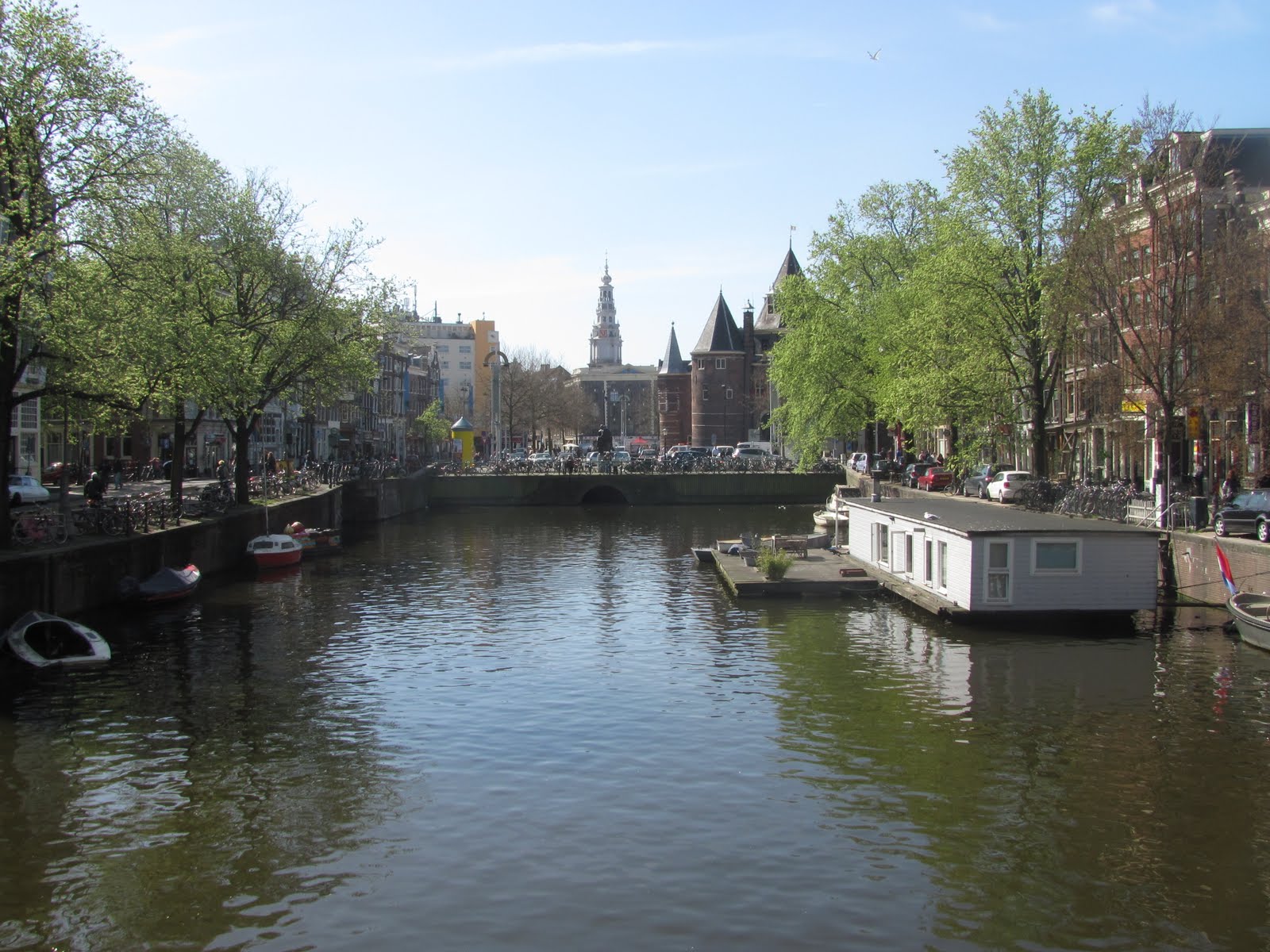
Amsterdam-City of Contrasts
Oh Amsterdam,what an amazing city you are--in so many different ways.So quaint and perty with the canals crisscrossing the city and the row houses lined up on either side showing off all of that gorgeous art deco stylings. Your beautiful flowers and yummy open air markets. Your friendly people and incredible art. Your Anne Franks and Ahhh yes, and then of course you have all that good pot and infamous red-light district. There is just something so amusing to have so much history and culture mixed in with so much...what do I call it? 
A trip to the market was a must. Just look at all of those different shrooms. Elsewhere I'm pretty sure there would be nothing but food on the mind but I learned that in Amsterdam--nothing is as innocent as it seems.

A trip to the market was a must. Just look at all of those different shrooms. Elsewhere I'm pretty sure there would be nothing but food on the mind but I learned that in Amsterdam--nothing is as innocent as it seems.
Mmmm, the bread was heavenly!
So are the Cannabis lolly's---or so I'm told.


We tried to get some bulbs to bring home but they have to be very particular to make it through customs on the way home. Aren't they gorgeous?
Oooh! The Cheese is to die for! I'd love to take a hunk just about this size home with me. Instead all we could manage was a piddly pounder of pesto cheese--but oh man was it ever yummy!


It is true about the bikes in Amsterdam--crazy and all over the place. This was one of my particular favorites.


Took a boat ride along the canals. Loved all of the bridges and funky architecture there. A lot of modern mixed in with very 17th century.


This is definitely as close to the red-light district as my camera was going to get. But let me tell you----They call it a red light--for a reason. When I picked my jaw up off the floor I couldn't help but be so incredibly sad by this whole scene. They say that it is all in the name of "freedom". Freedom/liberty, has never been for those who take it as a license to do anything that they want to. Sadly, someday, these snares that people deliberately walk into--just because they can--will spring shut, and they will have a heck of a time getting out again--to enjoy real freedom.
So are the Cannabis lolly's---or so I'm told.
We tried to get some bulbs to bring home but they have to be very particular to make it through customs on the way home. Aren't they gorgeous?
It is true about the bikes in Amsterdam--crazy and all over the place. This was one of my particular favorites.
We stopped for a bit to people watch in the large, central square. We got to see birds crap on people's hands that were crazy-ie. dumb-enough to feed them from their hands.
We even got to see Spiderman get busted by the cops! Usually in the main town squares all over Europe you'll have one or two funny "statue" people waiting for a handout. Here, in this square, there were probably 20 of them all over the place with all kinds of costumes on. Waiting for all of those sucker tourists to get a picture or something.
Sad! Italians get to be known for gelato (ice cream) and the Americans get to be known for what? Hot dogs--from a can no less!
If I happened to be a drinker, I might have brought this idea home to Moscow. I'm pretty sure that we could make a fortune here in this bike happy, college town. If you look close up on the bridge (click on the pict. to make it bigger) you'll notice a big long bar with stools along both sides. Every seat just happens to have pedals to go along with it. They call it a "Beerbike". Whenever you want a drink you just hop on and everyone starts pedaling. It's a mobile bar on wheels. Talk about drinking and driving!
Took a boat ride along the canals. Loved all of the bridges and funky architecture there. A lot of modern mixed in with very 17th century.
Dinner was "typical Dutch". and we loved it. Very delish!
Then came all of the "after-dinner" entertainment. I'm pretty sure that we should have probably gotten back to the hotel before the sun went down.----Cause truth be known, it's not just the red-light district that you have to worry about.
Just about any street in town can have a little surprise waiting for your unsuspecting eyes behind street-level glass doors. Let's just say that they DO NOT leave much to your imagination.
Anyone need to do a little "family planning"? I have to admit, We laughed for quite a while about these babies. SERIOUSLY??? We thought about getting the Eiffel tower one--just for a souvineer. Rats, too bad they were already closed.
Saturday, June 11, 2011
Final Tidbits of London
I thought these were so neat. The detail work on both these wooden pieces and the abalone jewelry was phenomenal. You can click on them to enlarge them and you will see what I'm talking about.
OK! Seriously, How cool are these fun "suitcase" bags made out of recycled mens suits? We were strolling through some fun shops near Drury lane and these caught my eye. They were selling for about 38 pounds (apx. $75) I wonder if something like that would sell at the farmers market?

I always get a chuckle out of the statue men. It seems they are in all of the main tourist squares all around the world. (except for maybe Tiannenmen Square)

It was kind of interesting to see this big ol' battleship just hangin' out in the Thames. I'm honestly not sure if its some sort of naval museum now or if it is a real, working battleship. I guess that gives you a little perspective as to how big the Thames is.

It seems that EVERYONE smokes in Europe these days. Maybe that's why we got a kick out of the huge anti-smoking messages on the back of all the cartons of cigarrettes. We were strolling along the Thames and found this under the famous London Bridge that you can see in the background. We couldn't resist the photo-op.
I always get a chuckle out of the statue men. It seems they are in all of the main tourist squares all around the world. (except for maybe Tiannenmen Square)
It was kind of interesting to see this big ol' battleship just hangin' out in the Thames. I'm honestly not sure if its some sort of naval museum now or if it is a real, working battleship. I guess that gives you a little perspective as to how big the Thames is.
It seems that EVERYONE smokes in Europe these days. Maybe that's why we got a kick out of the huge anti-smoking messages on the back of all the cartons of cigarrettes. We were strolling along the Thames and found this under the famous London Bridge that you can see in the background. We couldn't resist the photo-op.
Friday, May 27, 2011
Tower of London-My fave!
The Tower of London is admired for its architecture and its history but it is most remembered for the bloody executions, imprisonment and torture of the prisoners who were incarcerated in the great London castle. The mysterious deaths, like those of the two little Princes in the Tower and the tragic story of the execution of the pathetically young Lady Jane Grey. the execution of Queens of England - Catherine Howard and Anne Boleyn. The torture of various prisoners including the racking of Anne Askew, the interrogation of State prisoners such as Guy Fawkes. The executions of men of peace like John Fisher Bishop of Rochester and Sir Thomas More.
The type of execution of the Tower of London prisoners depended on the severity of the crime and whether the prisoners were members of the higher or lower classes - most executions were conducted in public. The vast majority of Tower of London prisoners who were sentenced to death met their end in public on Tower Hill. But private executions of Tower of London prisoners were conducted behind the walls of the Tower if the execution was considered too politically sensitive to carry out in open view - this especially applied to the execution of a woman. Even these 'private' executions on Tower Green were conducted in the full view of many important spectators. The victims of such executions were usually hurriedly buried in the Chapel Royal of St. Peter ad Vincula situated next to Tower Green.
Here is a partial list of some of the prisoners of the Tower. How many names do you recognize?
Bishop Ranulf Flambard - the first prisoner
Hubert de Burgh, Chief Justiciar of England (1232)
1238 - William le Marish
Prince Gruffydd of Wales ( fell 90 feet whilst trying to escape - 1244 )
King Baliol of Scotland (1296)
William Wallace (1305)
Lady Badlesmere, Margaret de Clare, first woman recorded as a prisoner of the Tower (1322)
Charles, Duke of Orleans (1391-1465)
Eleanor, Duchess of Gloucester 1441
King Henry VI 1465
Duke of Clarence 1478
1483 - William Hastings
1483 - Jane Shore
1483 The Two Princes - Edward V and his brother Richard, Duke of York
John Fisher Bishop of Rochester (1534)
Sir Thomas More (1535)
Implicated with Anne Boleyn - Mark Smeaton, Henry Norris, Frances Weston, William Brereton and George Boleyn (1536) NB Sir Thomas Wyatt was also arrested and imprisoned but was released
Sir William de la Pole was incarcerated at the Tower for 37 years
Thomas Cromwell (1540)
Implicated with Catherine Howard - Anne Howard, Thomas Culpepper, Henry Mannox & Francis Dereham(1542)
Protestant Anne Askew tortured at the Tower (1545)
Henry Howard, Earl of Surrey (1546)
Thomas, Duke of Norfolk (1546)
Princess Elizabeth and her servants Kat Ashley and Henry Parry (1554)
Thomas Seymour, High Admiral of England (1549)
The Duchess of Somerset (1551)
Edward Seymour, Duke of Somerset and Lord Protector (1552)
Guildford Dudley - husband of Lady Jane Grey (1554)
Hugh Draper of Bristol - sorcerer (1561)
John Store (1571)
Guy Fawkes (1606)
Nicholas Owen Jesuit builder of priests' holes (1606)
Thomas Overbury (1613)
Sir Walter Raleigh - first imprisoned for 13 years then released but eventually executed (1618)
Thomas Wentworth, Earl of Strafford (1641)
William Laud, Archbishop of Canterbury (1645)
James Scott, Duke of Monmouth (1685)
1780, the only American prisoner, Henry Laurens
Sir Francis Burdett
The Cato-street Conspirators
Roger Casement
Norman Baillie-Stewart in 1933-1937
Corporal Josef Jakobs
Rudolf Hess
The Kray Twins
This is the building that houses the Crown Jewels. Sadly, no pictures of the jewels were allowed but they were definitely impressive.
The Crown Jewels of England contain a fabulous collection of precious jewels set in the regalia used by the Royal family. England is the only European monarchy which still uses its regalia for the coronation ceremony when crowning a new Sovereign. The Crown jewels of England contain two of the most famous diamonds in the World - the Cullinan Diamond, also called the Great Star of Africa and the Kohinoor Diamond. The Crown Jewels of England contain magnificent regal emblems including coronets, crowns, sceptres and orbs. The King's Crown alone contains 2818 diamonds, 297 pearls, and many other jewels and weighs over thirty-nine ounces. Ancient objects are also included in the Crown Jewels collection such as gold plate, insignia and swords.
Traitors Gate:
The History of the Tower of London is bloody and cruel and Traitor's Gate has its part to play in its story. The water-gate under St Thomas's Tower has been known for over 400 years as 'Traitors' Gate' because of the number of prisoners, accused of treason, who have passed through it. Unfortunate and important state prisoners were committed to the Tower of London through the River Thames entrance to the Tower of London called Traitors Gate. The journey of these prisoners was made by barge along the River Thames. Often their journey would take them past London Bridge where the heads of recently executed traitors were displayed on the roof of the stone gate house. The heads were placed on spikes, attached to poles and displayed on the Bridge. The young and tragic Catherine Howard had to pass the gruesome sight of the head of her lover Thomas Culpepper on her journey to the Tower of London and Traitors Gate. This grisly practice continued until around 1678.
Traitors Gate - the famous entrance to the Tower of London
The famous entrance to the Tower of London, Traitors Gate, can be clearly seen by anyone passing up or down the River Thames. This infamous water-gate entrance to the Tower of London was designed by the Medieval architect Master James of St George on the orders of King Edward I between 1275 and 1279 as part of St Thomas's Tower. It was originally built to provide a new water-gate by which King Edward could arrive at the Tower by river. St Thomas's Tower provided additional royal accommodation for the King and his family. The function of the Tower of London was originally to provide royal power base in the City of London and to provide a retreat for the Royal family in times of civil disorder. This changed over the years and was increasingly used as a prison for enemies of the state accused of treason which was entered via Traitors Gate. The Tower was last used as a Royal residence by Anne Boleyn when she was preparing for her coronation. It was a tradition that new Kings and Queens of England would make their way from the Tower of London to Westminster Abbey for their coronation. The death of Anne Boleyn heralded the increased use of the Tower as a prison. The water-gate under St Thomas's Tower has been known for over 300 years as 'Traitors Gate' because of the number of prisoners, accused of treason, who have passed through it.
Anne Boleyn at Traitors Gate
The story of Anne Boleyn and her journey through Traitors Gate is a very poignant one. The twenty-nine year old Queen of England was arrested on the charges of treason, adultery and incest. Never a popular Queen she had been reviled by the population with cries of "Witch" and "Whore" and detested by many courtiers. King Henry VIII had been madly in love with her but this soon turned to hate when he met Jane Seymour. Her enemies moved swiftly against her and people started to disappear from court. Sir Henry Norris and the Queen's own brother, George Boleyn, Lord Rochford were arrested and taken to the Tower of London by barge and through the Traitors Gate entrance. On May 2 1536, the Queen herself was arrested at Greenwich and was taken to the Tower by barge along the same path she had travelled to prepare for her coronation just three years earlier. She passed through Traitors Gate and was met by William Kingston the Constable of the Tower at the top of the slippery steps leading from Traitors Gate. Her first question was: 'Shall I go to some dungeon?' Kingston replied, 'No, madam, you shall go to your chambers whereat your Grace lay before your Coronation.' Anne Boleyn was terrified and alternated from fits of hysterical laughter to uncontrollable weeping. She was executed on 19th May 1536.
Princess Elizabeth at Traitors Gate
The story of Princess Elizabeth, the future Queen Elizabeth I, and her journey through Traitors Gate is an equally frightening one. Her sister Queen Mary (Bloody Mary) ordered her arrest believing that the Princess was involved with Sir Thomas Wyatt and a rebellious plot. Princess Elizabeth was taken on Palm Sunday 1554, by barge, to the entrance of the Tower of London - Traitors Gate. Her thoughts must have raced back to that of her mother, Anne Boleyn, who had also passed through Traitors Gate and had been executed at the Tower when Elizabeth was just three years old. The princess was terrified - she believed that she would never leave the Tower once she had passed through Traitors Gate. Elizabeth refused at first to land at the gate, angrily proclaiming that she was no traitor. There was a heavy down pour of rain. Elizabeth had no choice but to be lead into the Tower. At the age of 21, Princess Elizabeth was taken through the Traitors Gate and imprisoned in the Tower of London. She was released 8 weeks later.
Hubert de Burgh, Chief Justiciar of England (1232)
1238 - William le Marish
Prince Gruffydd of Wales ( fell 90 feet whilst trying to escape - 1244 )
King Baliol of Scotland (1296)
William Wallace (1305)
Lady Badlesmere, Margaret de Clare, first woman recorded as a prisoner of the Tower (1322)
Charles, Duke of Orleans (1391-1465)
Eleanor, Duchess of Gloucester 1441
King Henry VI 1465
Duke of Clarence 1478
1483 - William Hastings
1483 - Jane Shore
1483 The Two Princes - Edward V and his brother Richard, Duke of York
John Fisher Bishop of Rochester (1534)
Sir Thomas More (1535)
Implicated with Anne Boleyn - Mark Smeaton, Henry Norris, Frances Weston, William Brereton and George Boleyn (1536) NB Sir Thomas Wyatt was also arrested and imprisoned but was released
Sir William de la Pole was incarcerated at the Tower for 37 years
Thomas Cromwell (1540)
Implicated with Catherine Howard - Anne Howard, Thomas Culpepper, Henry Mannox & Francis Dereham(1542)
Protestant Anne Askew tortured at the Tower (1545)
Henry Howard, Earl of Surrey (1546)
Thomas, Duke of Norfolk (1546)
Princess Elizabeth and her servants Kat Ashley and Henry Parry (1554)
Thomas Seymour, High Admiral of England (1549)
The Duchess of Somerset (1551)
Edward Seymour, Duke of Somerset and Lord Protector (1552)
Guildford Dudley - husband of Lady Jane Grey (1554)
Hugh Draper of Bristol - sorcerer (1561)
John Store (1571)
Guy Fawkes (1606)
Nicholas Owen Jesuit builder of priests' holes (1606)
Thomas Overbury (1613)
Sir Walter Raleigh - first imprisoned for 13 years then released but eventually executed (1618)
Thomas Wentworth, Earl of Strafford (1641)
William Laud, Archbishop of Canterbury (1645)
James Scott, Duke of Monmouth (1685)
1780, the only American prisoner, Henry Laurens
Sir Francis Burdett
The Cato-street Conspirators
Roger Casement
Norman Baillie-Stewart in 1933-1937
Corporal Josef Jakobs
Rudolf Hess
The Kray Twins
The Crown Jewels of England contain a fabulous collection of precious jewels set in the regalia used by the Royal family. England is the only European monarchy which still uses its regalia for the coronation ceremony when crowning a new Sovereign. The Crown jewels of England contain two of the most famous diamonds in the World - the Cullinan Diamond, also called the Great Star of Africa and the Kohinoor Diamond. The Crown Jewels of England contain magnificent regal emblems including coronets, crowns, sceptres and orbs. The King's Crown alone contains 2818 diamonds, 297 pearls, and many other jewels and weighs over thirty-nine ounces. Ancient objects are also included in the Crown Jewels collection such as gold plate, insignia and swords.
The History of the Tower of London is bloody and cruel and Traitor's Gate has its part to play in its story. The water-gate under St Thomas's Tower has been known for over 400 years as 'Traitors' Gate' because of the number of prisoners, accused of treason, who have passed through it. Unfortunate and important state prisoners were committed to the Tower of London through the River Thames entrance to the Tower of London called Traitors Gate. The journey of these prisoners was made by barge along the River Thames. Often their journey would take them past London Bridge where the heads of recently executed traitors were displayed on the roof of the stone gate house. The heads were placed on spikes, attached to poles and displayed on the Bridge. The young and tragic Catherine Howard had to pass the gruesome sight of the head of her lover Thomas Culpepper on her journey to the Tower of London and Traitors Gate. This grisly practice continued until around 1678.
Traitors Gate - the famous entrance to the Tower of London
The famous entrance to the Tower of London, Traitors Gate, can be clearly seen by anyone passing up or down the River Thames. This infamous water-gate entrance to the Tower of London was designed by the Medieval architect Master James of St George on the orders of King Edward I between 1275 and 1279 as part of St Thomas's Tower. It was originally built to provide a new water-gate by which King Edward could arrive at the Tower by river. St Thomas's Tower provided additional royal accommodation for the King and his family. The function of the Tower of London was originally to provide royal power base in the City of London and to provide a retreat for the Royal family in times of civil disorder. This changed over the years and was increasingly used as a prison for enemies of the state accused of treason which was entered via Traitors Gate. The Tower was last used as a Royal residence by Anne Boleyn when she was preparing for her coronation. It was a tradition that new Kings and Queens of England would make their way from the Tower of London to Westminster Abbey for their coronation. The death of Anne Boleyn heralded the increased use of the Tower as a prison. The water-gate under St Thomas's Tower has been known for over 300 years as 'Traitors Gate' because of the number of prisoners, accused of treason, who have passed through it.
Anne Boleyn at Traitors Gate
The story of Anne Boleyn and her journey through Traitors Gate is a very poignant one. The twenty-nine year old Queen of England was arrested on the charges of treason, adultery and incest. Never a popular Queen she had been reviled by the population with cries of "Witch" and "Whore" and detested by many courtiers. King Henry VIII had been madly in love with her but this soon turned to hate when he met Jane Seymour. Her enemies moved swiftly against her and people started to disappear from court. Sir Henry Norris and the Queen's own brother, George Boleyn, Lord Rochford were arrested and taken to the Tower of London by barge and through the Traitors Gate entrance. On May 2 1536, the Queen herself was arrested at Greenwich and was taken to the Tower by barge along the same path she had travelled to prepare for her coronation just three years earlier. She passed through Traitors Gate and was met by William Kingston the Constable of the Tower at the top of the slippery steps leading from Traitors Gate. Her first question was: 'Shall I go to some dungeon?' Kingston replied, 'No, madam, you shall go to your chambers whereat your Grace lay before your Coronation.' Anne Boleyn was terrified and alternated from fits of hysterical laughter to uncontrollable weeping. She was executed on 19th May 1536.
Princess Elizabeth at Traitors Gate
The story of Princess Elizabeth, the future Queen Elizabeth I, and her journey through Traitors Gate is an equally frightening one. Her sister Queen Mary (Bloody Mary) ordered her arrest believing that the Princess was involved with Sir Thomas Wyatt and a rebellious plot. Princess Elizabeth was taken on Palm Sunday 1554, by barge, to the entrance of the Tower of London - Traitors Gate. Her thoughts must have raced back to that of her mother, Anne Boleyn, who had also passed through Traitors Gate and had been executed at the Tower when Elizabeth was just three years old. The princess was terrified - she believed that she would never leave the Tower once she had passed through Traitors Gate. Elizabeth refused at first to land at the gate, angrily proclaiming that she was no traitor. There was a heavy down pour of rain. Elizabeth had no choice but to be lead into the Tower. At the age of 21, Princess Elizabeth was taken through the Traitors Gate and imprisoned in the Tower of London. She was released 8 weeks later.
Just a little trivia I picked up. This is just plain crazy----Can you even imagine?
Following execution the severed head was held up by the hair by the executioner. This was done, not as many people think to show the crowd the head, but in fact to show the head the faces of crowd and it's own body! Killing by beheading is not immediate. Consciousness remains for at least eight seconds after beheading until lack of oxygen causes unconsciousness and eventually death.
This little grassy area is the Tower Green where many of the 'private' executions took place. Some of them lived in the houses just behind. In fact I think this one was called the "Queen's House" and was built for Anne Boleyn and was where she lived before her coronation and again before being executed right outside her own front window.
The private executions conducted on Tower Green include the most poignant of many of the Tower of London prisoners:
13th June 1483
Execution by Beheading
William Hastings, 1st Baron Hastings (1431 - 1483)
William Hastings fought to secure the throne for Edward IV. He was appointed Lord Chamberlain in 1461. When King Edward died in 1483 he was a staunch and loyal supporter of King Edward's young son - Edward V, one of the tragic little Princes in the Tower. He was arrested on charges of treason by the dead King Edward IV's brother Richard on route to the young prince's coronation.
The two little princes were declared illegitimate and, as next in line to the throne, their uncle and Protector, Richard, Duke of Gloucester, was declared the true King and was crowned Richard III. The two little princes were never seen again. And William Hastings was executed without trial. It is said that they were killed and buried in the stairwell of the Bloody Tower but of course, true to any real life mystery they aren't quite sure which tower they seem to have been killed in and buried beneath. Different theories abound.
19th May 1536
Execution by Beheading
Anne Boleyn, Queen of England (1507- 1536)
Anne Boleyn was the second wife of King Henry VIII. He divorced his wife, Katherine of Aragon, broke with Rome and was excommunicated, for the love of this woman. Then lost interest, fell in love with Jane Seymour and had her arrested on the charges of treason, adultery and incest with her brother George Boleyn, Lord Rochford. Death by the axe was a terrifying prospect. The executioners often took several blows before the head was finally severed. Anne was therefore granted some clemency and a swordsman was called from France to undertake the execution. When she talked of her execution and referred to the comforting fact that she "only had a little neck."
27th May 1541
Execution by Beheading
Margaret Pole, Countess of Salisbury (1473-1541)
The Countess of Salisbury was the last direct descendant of the Plantagenet line - she was as descendent of King Edward III. The countess made the mistake of appearing to side with Katherine of Aragon against the king and he declared her a traitor. She was arrested two years before her execution and badly treated and neglected as a prisoner in the Tower of London. She was not given a trial. She was small, frail and ill. But she was a proud noble. She was dragged to the block, but refused to lay her head on the block. She was forced down and struggled. The inexperienced executioner made a gash in her shoulder rather than her neck. She leapt from the block and was chased by the executioner, with his axe. She was struck eleven times before she died. There were 150 witnesses to her execution. She was 68 years of age.
13th February 1542
Execution by Beheading
Catherine Howard, Queen of England (1524 - 1542)
Catherine Howard was the pretty fifth wife of King Henry VIII and the cousin of Anne Boleyn. Henry was besotted with her, calling her his 'Rose without a Thorn' and showered her with gifts and public affection. She had led a permissive life in the household of her grandmother, the Dowager Duchess of Norfolk. and was an uneducated, neglected girl. After her marriage to Henry VIII who was an old, repulsive, obese man, she had an affair with the young and handsome Thomas Culpepper. And was found out. King Henry was devastated. Catherine was arrested at Hampton Court for adultery and tried in vain to reach the King. She was dragged screaming back to her apartments. Her lovers were executed and she passed their gruesome, impaled heads on London Bridge on her way to Traitor's gate, the entry to the Tower of London. Catherine asked William Kingston for a block so that she could practise her execution. Legend has it that Catherine's last words were: "I die a queen, but would rather die the wife of Culpepper."
She was just 18 years old.
13th February 1542
Execution by Beheading
Jane Boleyn, Viscountess Rochford (1505 - 1542)
Jane Rochford was the wife of George Boleyn, the brother of Queen Anne Boleyn who had been executed on the trumped up charge of incest with his sister. Jane Rochford was a spiteful, jealous woman. Her marriage to George Boleyn was an arranged and unhappy one. She was instrumental in the arrest of her sister-in-law, Anne and her husband George Boleyn, providing damning evidence against them to Thomas Cromwell. Her sworn affidavit helped convict them of incest and treason. The allegations were completely false. She later became a Lady of the Privy Chamber to Catherine Howard. Jane Rochford revelled in intrigue and encouraged the young queen in her affair with Thomas Culpepper with whom she helped organised secret meetings. Her part as a go-between was discovered and Jane Rochford was arrested and taken to the Tower of London. She was interrogated and lost her sanity. A new law which allowed the execution of the insane was passed in order to have her condemned to death. She confessed before her death, "God has permitted me to suffer this shameful doom as punishment for having contributed to my husband's death. I falsely accused him of loving in an incestuous manner, his sister, Queen Anne Boleyn. For this I deserve to die." She was executed immediately after poor, tragic Catherine Howard.
12th February 1554
Execution by Beheading
Lady Jane Grey, Queen of England (1537–1554)
Lady Jane Grey was Queen of England for just Nine Days from Monday 10th July 1553 to Wednesday 19th July 1553. Edward V a devout Protestant and Henry VIII's only son, died of tuberculosis and he left the throne to 'the Lady Jane and her heirs male.' Lady Jane Grey was the puppet of her ambitious parents the powerful Dudley family. She was proclaimed Queen of England and the Protestant Queen Jane and her husband Guildford Dudley were taken in full state from Syon House to the Royal Apartments in the Tower of London. On 19th July 1553 Queen Jane was deposed as Queen, she raised no objection - the Catholic Princess Mary was the rightful heir. Lady Jane Grey and her husband were imprisoned in the Tower. On 12th February 1554 Lady Jane Grey and her husband Guildford Dudley were executed at the Tower of London. Lady Jane watched her husband go from the Beauchamp Tower to his death on Tower Hill, a few hours before her own execution on the Green. Jane's death warrant was signed by Queen Mary later known as 'Bloody Mary' for her persecution of Protestants.
Lady Jane Grey was just 17 years old.
25th February 1601
Execution by Beheading
Robert Devereux 2nd Earl of Essex (1566 - 1601)
The Earl of Essex was a favourite of Queen Elizabeth I. He was handsome, witty, arrogant and ambitious and the Queen heaped favours upon her favourite. Essex was made Lord Lieutenant of Ireland - a post in which he failed dismally. His relationship with the Queen deteriorated and he attempted a political coup. He lead a rebellion against Queen Elizabeth and attempted to seize control of the City of London on February 8th 1601. He was arrested and convicted of treason. Dressed in black, but with a bright red waistcoat, Essex executed at the Tower of London on February 25, 1601. Over 100 people witnessed the execution - three strokes of the axe were needed to sever Essex's head.

The Tower of London also holds England's national collection of arms and armour. If you have any interest in arms or armour, this is a must-see attraction for you. It was fascinating. This one just happens to be my personal favorite. They were definitely concerned about keeping the family jewels safe weren't they. I don't remember whose armour this was but I think it's safe to say that whoever it was happened to be a bit of an egotistical sort of man, don't ya think?
Evidently the White Tower--or main palace complex was somewhat ahead of its time. It happened to have indoor plumbing! ..........Which consisted of a wooden bench seat with a hole in the middle. A hole was tunneled through the rock wall to the outside. Then whenever someone had to go it was..."Look out below!"

This is a fun shot with the Tower Bridge in the background--I think one of the coolest bridges in the world.
The tower on the left connected to the battlements is the Salt Tower. There were lots of different inscriptions and stuff on all of the walls of the various different towers where different prisoners had stayed. Here are a few stories from the Salt Tower prisoners.
If you click on the picture you can enlarge it enough to read it.
Following execution the severed head was held up by the hair by the executioner. This was done, not as many people think to show the crowd the head, but in fact to show the head the faces of crowd and it's own body! Killing by beheading is not immediate. Consciousness remains for at least eight seconds after beheading until lack of oxygen causes unconsciousness and eventually death.
The private executions conducted on Tower Green include the most poignant of many of the Tower of London prisoners:
13th June 1483
Execution by Beheading
William Hastings, 1st Baron Hastings (1431 - 1483)
William Hastings fought to secure the throne for Edward IV. He was appointed Lord Chamberlain in 1461. When King Edward died in 1483 he was a staunch and loyal supporter of King Edward's young son - Edward V, one of the tragic little Princes in the Tower. He was arrested on charges of treason by the dead King Edward IV's brother Richard on route to the young prince's coronation.
The two little princes were declared illegitimate and, as next in line to the throne, their uncle and Protector, Richard, Duke of Gloucester, was declared the true King and was crowned Richard III. The two little princes were never seen again. And William Hastings was executed without trial. It is said that they were killed and buried in the stairwell of the Bloody Tower but of course, true to any real life mystery they aren't quite sure which tower they seem to have been killed in and buried beneath. Different theories abound.
19th May 1536
Execution by Beheading
Anne Boleyn, Queen of England (1507- 1536)
Anne Boleyn was the second wife of King Henry VIII. He divorced his wife, Katherine of Aragon, broke with Rome and was excommunicated, for the love of this woman. Then lost interest, fell in love with Jane Seymour and had her arrested on the charges of treason, adultery and incest with her brother George Boleyn, Lord Rochford. Death by the axe was a terrifying prospect. The executioners often took several blows before the head was finally severed. Anne was therefore granted some clemency and a swordsman was called from France to undertake the execution. When she talked of her execution and referred to the comforting fact that she "only had a little neck."
27th May 1541
Execution by Beheading
Margaret Pole, Countess of Salisbury (1473-1541)
The Countess of Salisbury was the last direct descendant of the Plantagenet line - she was as descendent of King Edward III. The countess made the mistake of appearing to side with Katherine of Aragon against the king and he declared her a traitor. She was arrested two years before her execution and badly treated and neglected as a prisoner in the Tower of London. She was not given a trial. She was small, frail and ill. But she was a proud noble. She was dragged to the block, but refused to lay her head on the block. She was forced down and struggled. The inexperienced executioner made a gash in her shoulder rather than her neck. She leapt from the block and was chased by the executioner, with his axe. She was struck eleven times before she died. There were 150 witnesses to her execution. She was 68 years of age.
13th February 1542
Execution by Beheading
Catherine Howard, Queen of England (1524 - 1542)
Catherine Howard was the pretty fifth wife of King Henry VIII and the cousin of Anne Boleyn. Henry was besotted with her, calling her his 'Rose without a Thorn' and showered her with gifts and public affection. She had led a permissive life in the household of her grandmother, the Dowager Duchess of Norfolk. and was an uneducated, neglected girl. After her marriage to Henry VIII who was an old, repulsive, obese man, she had an affair with the young and handsome Thomas Culpepper. And was found out. King Henry was devastated. Catherine was arrested at Hampton Court for adultery and tried in vain to reach the King. She was dragged screaming back to her apartments. Her lovers were executed and she passed their gruesome, impaled heads on London Bridge on her way to Traitor's gate, the entry to the Tower of London. Catherine asked William Kingston for a block so that she could practise her execution. Legend has it that Catherine's last words were: "I die a queen, but would rather die the wife of Culpepper."
She was just 18 years old.
13th February 1542
Execution by Beheading
Jane Boleyn, Viscountess Rochford (1505 - 1542)
Jane Rochford was the wife of George Boleyn, the brother of Queen Anne Boleyn who had been executed on the trumped up charge of incest with his sister. Jane Rochford was a spiteful, jealous woman. Her marriage to George Boleyn was an arranged and unhappy one. She was instrumental in the arrest of her sister-in-law, Anne and her husband George Boleyn, providing damning evidence against them to Thomas Cromwell. Her sworn affidavit helped convict them of incest and treason. The allegations were completely false. She later became a Lady of the Privy Chamber to Catherine Howard. Jane Rochford revelled in intrigue and encouraged the young queen in her affair with Thomas Culpepper with whom she helped organised secret meetings. Her part as a go-between was discovered and Jane Rochford was arrested and taken to the Tower of London. She was interrogated and lost her sanity. A new law which allowed the execution of the insane was passed in order to have her condemned to death. She confessed before her death, "God has permitted me to suffer this shameful doom as punishment for having contributed to my husband's death. I falsely accused him of loving in an incestuous manner, his sister, Queen Anne Boleyn. For this I deserve to die." She was executed immediately after poor, tragic Catherine Howard.
12th February 1554
Execution by Beheading
Lady Jane Grey, Queen of England (1537–1554)
Lady Jane Grey was Queen of England for just Nine Days from Monday 10th July 1553 to Wednesday 19th July 1553. Edward V a devout Protestant and Henry VIII's only son, died of tuberculosis and he left the throne to 'the Lady Jane and her heirs male.' Lady Jane Grey was the puppet of her ambitious parents the powerful Dudley family. She was proclaimed Queen of England and the Protestant Queen Jane and her husband Guildford Dudley were taken in full state from Syon House to the Royal Apartments in the Tower of London. On 19th July 1553 Queen Jane was deposed as Queen, she raised no objection - the Catholic Princess Mary was the rightful heir. Lady Jane Grey and her husband were imprisoned in the Tower. On 12th February 1554 Lady Jane Grey and her husband Guildford Dudley were executed at the Tower of London. Lady Jane watched her husband go from the Beauchamp Tower to his death on Tower Hill, a few hours before her own execution on the Green. Jane's death warrant was signed by Queen Mary later known as 'Bloody Mary' for her persecution of Protestants.
Lady Jane Grey was just 17 years old.
25th February 1601
Execution by Beheading
Robert Devereux 2nd Earl of Essex (1566 - 1601)
The Earl of Essex was a favourite of Queen Elizabeth I. He was handsome, witty, arrogant and ambitious and the Queen heaped favours upon her favourite. Essex was made Lord Lieutenant of Ireland - a post in which he failed dismally. His relationship with the Queen deteriorated and he attempted a political coup. He lead a rebellion against Queen Elizabeth and attempted to seize control of the City of London on February 8th 1601. He was arrested and convicted of treason. Dressed in black, but with a bright red waistcoat, Essex executed at the Tower of London on February 25, 1601. Over 100 people witnessed the execution - three strokes of the axe were needed to sever Essex's head.
The Tower of London also holds England's national collection of arms and armour. If you have any interest in arms or armour, this is a must-see attraction for you. It was fascinating. This one just happens to be my personal favorite. They were definitely concerned about keeping the family jewels safe weren't they. I don't remember whose armour this was but I think it's safe to say that whoever it was happened to be a bit of an egotistical sort of man, don't ya think?
This is a fun shot with the Tower Bridge in the background--I think one of the coolest bridges in the world.
I think that this is the bridge that goes across to the Wakefield Tower. The Traitors Gate entrance is just past this bridge.
I found that the more you know about the history, the more interesting this place becomes. We spent a lot of time here and I loved every minute of it. It was just so much fun to walk these grounds, listen to the yeoman warders, check out all of the historical artifacts, oogle the jewels and mostly just marval at all of the historical figures and their insane life stories. Their lives were CRAZY! I just kept saying to either myself or to Jeff, "Can you imagine...?" It was all so unbelievable--and yet, it really happened.
Sunday, May 22, 2011
London
We rode the high speed train from Paris through the chunnel and on to London. It only took about 3 hours. How cool is that. I was so hoping to get pictures of the chunnel but because the train really is going so fast and because they have to build the tunnel so far in land, we didn't even see the ocean. It just got dark outside all of a sudden. Also you could definitely tell a difference in pressure on your ears. To go through the tunnel it took us about 20 minutes or so.

First thing after a quick stop at the hotel was to find some tickets for Wicked.
We headed on down to Leicechester square. Picked up some great tickets, ate the requisite fish and chips in a pub
and wandered through a sea of humanity until we came to one of the coolest toystores in the world. They had demos of all of the fun, unique toys--from fingernail design sets to make your own stickers, to personalized CD's and alarm clocks. They had robotic cars and magic sets. You name it, they probably had it. Did we buy anything? Sadly no, I would have had to sell the children that said toys were supposed to be for in order to pay for those toys.
First thing after a quick stop at the hotel was to find some tickets for Wicked.
Westminster Abby was an interesting experience. We were excited to go and see it but when we got there we found out that they were charging over 30 pounds to go in. ---Convert that to dollars and you get around $60----per person. It is still hard for me to imagine charging someone to enter a church. There is just something not quite right about that in my mind. Anyway, we heard that if you tell the guards that you just want to go in and pray then they will let you in without paying. Well, I'm certainly not above a little praying now and then so we mosied over to the side door and asked the guard. He told us that they were just finishing up a mass and yes we were welcome to go in. So we snuck in the side door and went in to participate in the mass that was just finishing up. We had a woman priest which was also a little unusual for me. It was actually a very surreal experience for me. To be participating in rituals which had been performed for hundreds of years and yet were not quite understood until the restored gospel was brought forth once again. I just had such an overwhelming feeling of gratitude for my knowledge of The Church of Jesus Christ of Latter-Day Saints. I am so thankful that the truthfulness of this restored gospel has been witnessed to me by the Holy Ghost. All of those precious parts of the fulness of the gospel that have been lost are once again made clear. As I sat there listening and participating in the prayers and whatnot, I just wanted to stand up and shout that yes, what they have is based on the traditions of hundreds of years but that there is something more, something better, something PURE once again.
We were able to wander around just a bit after the service was over. We didn't get too carried away walking around since we didn't pay the fee. It was pretty fun just to be inside, taking it all in. I cannot begin to list off all of the famous people buried there. You have the likes of Isaac Newton, Charles Darwin, Charles Dickons, Elizabeth I, and Mary Queen of Scots to name just a few.

Big Ben--Was huge. Way bigger than I had anticipated.
The House of Lords must have been just getting out. It was kind of fun to see them all come out in their robes and wigs.
On our way over to the Tower of London we stopped at this little church tucked into a little niche between tall towering modern buildings on all sides. As soon as you stepped into the little garden it was like entering another world. It was so quiet and peaceful and sweet. We stopped outside for awhile and just sat on the bench enjoying the setting. The flowers were in bloom and the tombstones of unknown people were scattered throughout the little garden. After awhile we went inside to look around and the rector was giving a tour to a lady who was going to be giving a tour of her own to a group of people later on. We listened in for a while as he described all about the little church. Evidently it was one of very few churches that survived the great fire of 1666. I guess the flames licked the walls of the houses just a short distance away but just before it got to the church the wind kicked up or something and it turned and went a different direction.

It was fun to see the mounted police trotting along in Hyde Park.

Buckingham Palace. We missed the changing of the guard. They didn't do it the day we were there. We did get to see the mounted guards ride by. They were about 6 rows of 4 mounted guards. I was trying to get video on the fly and couldn't figure out why I wasn't getting a picture before realizing that my camera lense cover was still on. DUH!!! Oh well.

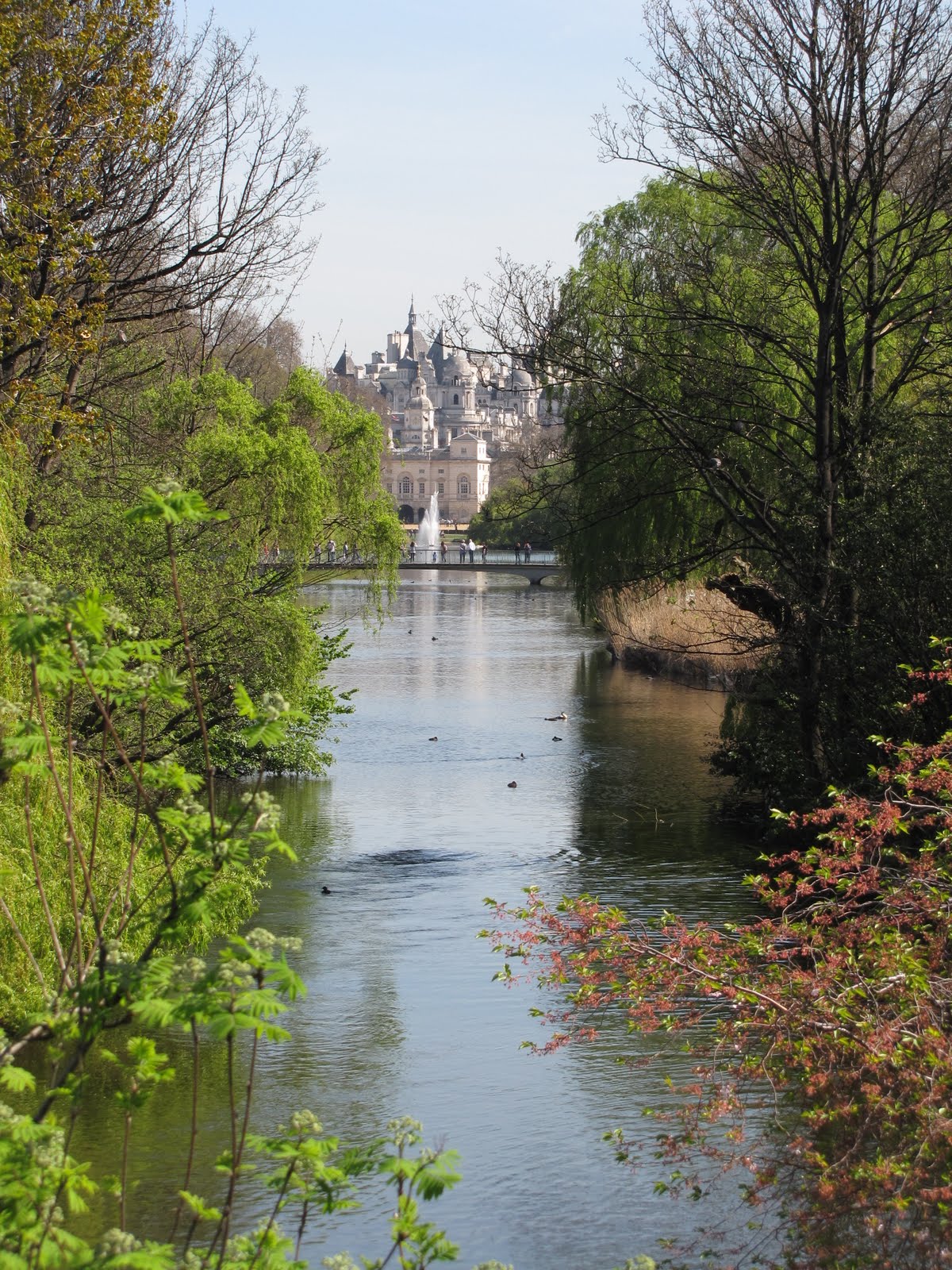
The view looking down St. James Park from near Buckingham palace. St. James Park was gorgeous! One of the prettiest parks that we have been able to stroll through. Buckingham palace is on one end. The Treasury and Foreign and Commonwealth buildings with the Churchill war rooms are on the other and St. James Palace is on the side near Buckingham.
Big Ben--Was huge. Way bigger than I had anticipated.
On our way over to the Tower of London we stopped at this little church tucked into a little niche between tall towering modern buildings on all sides. As soon as you stepped into the little garden it was like entering another world. It was so quiet and peaceful and sweet. We stopped outside for awhile and just sat on the bench enjoying the setting. The flowers were in bloom and the tombstones of unknown people were scattered throughout the little garden. After awhile we went inside to look around and the rector was giving a tour to a lady who was going to be giving a tour of her own to a group of people later on. We listened in for a while as he described all about the little church. Evidently it was one of very few churches that survived the great fire of 1666. I guess the flames licked the walls of the houses just a short distance away but just before it got to the church the wind kicked up or something and it turned and went a different direction.
It was fun to see the mounted police trotting along in Hyde Park.
Buckingham Palace. We missed the changing of the guard. They didn't do it the day we were there. We did get to see the mounted guards ride by. They were about 6 rows of 4 mounted guards. I was trying to get video on the fly and couldn't figure out why I wasn't getting a picture before realizing that my camera lense cover was still on. DUH!!! Oh well.